This was the research I read out at the Wonnerup Massacre March in Busselton on 22nd February 2023 at the invitation of Bill Webb, Wardandi Traditional Owner, from the Wardan Centre at Injidup.
1801 Wardandi Country before colonisation as seen by the Baudin expedition
The Geographe Bay area in the south-west of Western Australia has been Wardandi Country for at least 45,000 years.[1] In 1801 a French expedition, led by Baudin, arrived at Geographe Bay and during their time here, the scientists observed a landscape shaped by fire with extensive fish trap systems and several Wardandi settlements.[2]

[The first poster displayed here is from a drawing by Charles Lesueur, who was an artist on the expedition. It shows Wardandi country near Wonnerup, including fish traps and dwellings, depicting the abundant and managed landscape]
Peaceful encounters with several Wardandi people and the number of footprints seen by the French indicated that a significant number of Wardandi people were living in the area.[3] The scientist Peron came across a sacred grove during his time onshore, saying that it inspired awe in him and was designed to ‘draw out the heart’s sweet emotions’. This grove is further evidence of Wardandi culture and society and their occupation and management of this Country.[4]
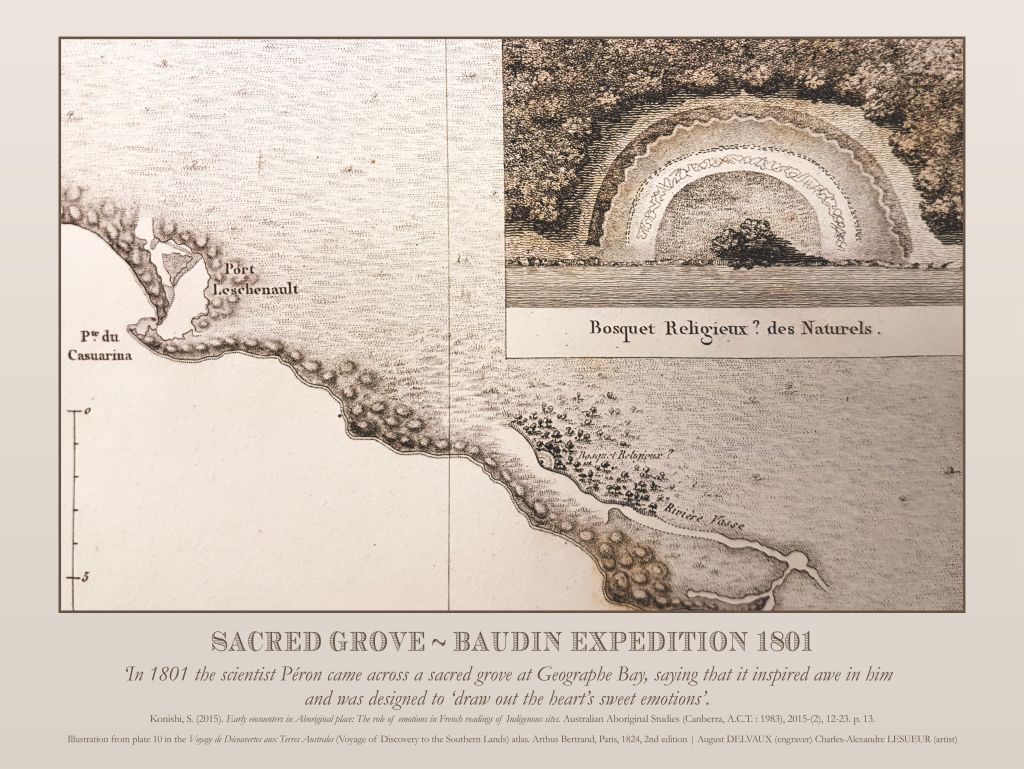
[This sacred grove is shown in the second poster here]
1829 Colonisation of the Swan River and massacres on Wadjuk Country
In 1829 the Swan River Colony was established up at Perth and James Stirling was the Governor there until 1839. During his time running the colony, several massacres on Wadjuk land occurred: The Galup massacre in 1830 at a location known today as Monger’s Lake,[5] a massacre at Success Hill near Guildford in 1831,[6] in the same month as one at Walyunga, north of Guildford,[7] and at least sixteen Wadjuk men[8] were killed by settlers during the time that Midgegooroo, Yagan and Weeip were leading the resistance against colonial violence in Perth. There are also most likely other colonial massacres on Wadjuk country that research has not yet brought to light. All of these massacres and killings were blamed on Wadjuk people taking food, but they were actually caused by the assumption of the colonists that they could take Noongar land and use it without permission or compensation.
1834 Colonisation of the Vasse and Wonnerup districts and the Pinjarra Massacre
On April 18, 1834 the colonisation of Wardandi country at Geographe Bay began when John, Charles, Vernon and Lenox Bussell, George Layman,[9] and the Chapman brothers arrived from Augusta with four soldiers from the 21st Regiment, who would be posted near the Bussell’s house at Cattle Chosen.[10] The Bussells and Captain John Molloy took land at the Vasse River, and the Chapmans and Layman later on took land up at Wonnerup.
During the same month, April 1834, in Perth, Calyute, the leader of a group of Pinjareb people living near Pinjarra, led a daring raid on Shenton’s flour mill in South Perth to obtain flour. In October 1834, Governor Stirling led a punitive party out to the area where they knew Calyute’s people lived, and attacked a group of about 70 Pinjareb people. According to a newspaper report, around 30 Pinjareb people were killed, with the colonial group focusing on killing the Pinjareb men, but six women and a little girl were also killed.[11] Two of the punitive party were wounded, and one later died. Pinjareb oral history says that many more people were killed, and that most of the Pinjareb men, including Calyute, were away on ceremonial purposes, so the group that was attacked comprised mainly elderly men, women and children.[12]
The Pinjarra Massacre is listed on the Massacre Map project that has been done by the University of Newcastle.[13] This project defines a massacre as being the deaths of 6 or more people and shows that colonial violence was widespread around Australia. While the Pinjarra Massacre was spoken about openly at the time it occurred, often a code of silence prevailed about punitive massacres, leading to a lack of knowledge today about them.
1836 Lieutenant Bunbury punitive action on Balladong Country. Later he walks through Pinjareb Country from Pinjarra to Wardandi Country
In June and July 1836, Lieutenant Bunbury was ‘ordered’ by Governor Stirling to go to York, ‘with a Detachment to make war’ on Balladong people.[14] On July 9, the Perth Gazette reported that several Balladong men and a woman had been killed.[15]
Lieutenant Bunbury was then posted to Pinjarra and he travelled from there to the Vasse in December 1836, guided by Monang, Calyute’s son.[16] During this three day trip Bunbury commented that during that day they had at least one hundred and sometimes two hundred Pibelmen people accompanying them, and when they crossed the Collie River they were greeted by a group of 150 Wardandi people as they went on towards the Preston River.[17] Lieutenant Bunbury was later sent to the Vasse in March 1837 to set up a barracks out at Wonnerup.[18] Towards the end of April 1837, he went to Perth for instruction on this and then was sent back to York by Governor Stirling.
1837 Massacres at York and the Vasse
The district of York is on Balladong Country, and in 1837 a cycle of violence between settlers and Balladong people began again. In July 1837, Balladong men Durgap and Garbung were arrested and sent to Perth to stand trial as part of a plan by Stirling to start trying Noongar people in court for offences against settler property. A Balladong man who volunteered to go with Durgap and Garbung to Perth became ill on the journey and was killed at Greenmount by the soldiers with them.[19]
In July 1837, at York, as payback for the arrest and removal to Perth of Durgap and Garbung, two settler servants called Peter Chidlow and Edward Jones were speared by a group of Balladong men.[20] Lieutenant Bunbury volunteered to go to York and he, and nineteen solders from the 21st Regiment, were sent to York with instructions from Stirling to perform ‘proper examples of Severity to the full extent to which the Law warrants in such cases’.[21] Bunbury was aided by Lieutenant Mortimer and Resident Magistrate McLeod in undertaking punitive activities in the York, Toodyay and Beverley districts that resulted in the deaths of at least eighteen Balladong people during July and August of 1837. This incident is also recorded on the Massacre Map.[22]
1837 Massacres at the Vasse district
While this was happening in York, during June and July of 1837 the first massacres of Wardandi people by Vasse settlers took place. At that time John Bussell was away in England seeking a wife and his brother Lenox was the Justice of Peace. The Molloy family was still living at Augusta.
In June 1837, a heifer belonging to the Chapman’s was speared and eaten by Gaywal and his family. A Wardandi man called Bobingroot was then forced to lead Alfred Bussell, two of the Chapman brothers, Constable Elijah Dawson and two soldiers from Wonnerup to a place known as Yulojoogarup,[23] near the Sabina River.[24] There the settlers killed nine and wounded two Wardandi people.[25] In response to Constable Elijah Dawson leading this massacre, on 13July, Wardandi men threw spears at him and his wife, wounding him in the arm.[26] On July 30 1837, Wardandi people could be heard shouting down near some abandoned huts. The soldiers and settlers went down to the estuary where they shot three Wardandi women, one man and a boy.[27]
1841 The Wonnerup massacre
Several years later, in 1841, a large punitive massacre took place on Wardandi country. By now the Molloys had left Augusta and moved up to the Vasse, John Bussell had returned from England with his new bride, and the Chapman brothers and George Layman had moved out to Wonnerup. Soldiers from the 21st Regiment had now been replaced with men from the 51st Regiment.[28] Captain Stirling had also been replaced by Governor Hutt, who had a more benign approach to the treatment of Noongar people. The arrival of a new Governor, however, did not make much difference to the violence that was going in the Swan River Colony.
Again, a cycle of violence had been going for some time at the Vasse, with settlers shooting Wardandi people for taking flour, while also hunting out the kangaroos in the area. Gaywal’s daughter was raped, and his son-in-law re-arrested after punishment for payback for this, and a dispute was going on between Gaywal and George Layman over Wardandi women working for him.[29]
On February 21,1841, Gaywal and other Wardandi people were working for George Layman out at Wonnerup, helping harvest and thresh a crop. That evening around the campfire outside of Layman’s hut a dispute broke out between Wardandi men Dr Miligan and Gaywal. George Layman came out and intervened, insulting Gaywal in the process, and Gaywal speared and killed him. The settlers, led by Resident Magistrate Captain John Molloy and Justice of the Peace John Bussell, then undertook several punitive expeditions over the next weeks. On 25February five Wardandi people were shot after being tracked through the sandhills by the settlers. The settlers pursued the Wardandi up to Lake Minninup, shooting several Wardandi people, but ‘were not satisfied’.[30] Finally, on a sandbar near Lake Minninup dozens of Wardandi were killed by the settlers according to a history of Western Australia published in 1897 and J. S Battye’s History of Western Australia published in 1924.[31] Wardandi oral history says that many more people were killed than the recorded here. Gaywal was not among the dead, so the hunt continued.[32] Finally on 7March 1841, Gaywal was shot and killed after a Wardandi man led the settlers to where he was hiding.[33]

[The massacres at Cattle Chosen in 1837 and at Wonnerup/Minninup in 1841 are also on the Massacre Map. The third poster shows details of where they are on the map. There is also a QR code to allow you to access the Massacre Map on your phone to see how extensive frontier violence was in Australia.]
Since that time there were many more massacres in Western Australia. Current research indicates that the most recent massacre in Western Australia was in the East Kimberley region in the 1930s when poisoned meat was given to Kija people at Panton River.
As research by academics is ongoing, I am sure many other colonial massacres in Western Australia will be revealed. It is important that they are documented thoroughly and acknowledged. We need to have a Truth and Reconciliation Commission in Western Australia, to acknowledge the violence of colonisation so that we can move forward to true Reconciliation.
References
[1] Bill Bunbury, Invisible Country: South-West Australia: Understanding a Landscape (Crawley, Western Australia: UWA Publishing, 2015). p. 150.
[2] Bill Gammage, The Biggest Estate on Earth: How Aborigines Made Australia (Allen & Unwin, 2011). p. 213. François Michel Ronsard, Journal nautique de François Michel Ronsard (tome 1), 1801, University of Sydney, The Baudin Legacy Project p. 18. Théodore Leschenault, Extrait du journal de Théodore Leschenault, 1801, University of Sydney, The Baudin Legacy Project p. 9-11.
[3] Pierre Bernard Milius et al., Pierre Bernard Milius: le dernier commandant de l’expédition Baudin: le journal 1800-1804, Milius: last commander of the Baudin expedition: the journal 1800-1804., (West Perth, Western Australia: Australian Capital Equity Pty Limited conjointement avec la National Library of Australia, 2013). p. 61.
[4] Shino Konishi, “Early encounters in Aboriginal place: The role of emotions in French readings of Indigenous sites,” Australian Aboriginal Studies (Canberra, A.C.T. : 1983) 2015-, no. 2 (2015). P. 13.
[5] See Colonial Frontier Massacres in Australia, 1788-1930, by University of Newcastle, https://c21ch.newcastle.edu.au/colonialmassacres/detail.php?r=885 for details.
[6] See Colonial Frontier Massacres in Australia, 1788-1930, by University of Newcastle, https://c21ch.newcastle.edu.au/colonialmassacres/detail.php?r=884 for details.
[7] Bevan Carter, Nyungah Land: Records of Invasion and Theft of Aboriginal Land on the Swan River 1829-1850 (Guildford: Swan Valley Nyungar Community, 2006). pp. 80-82.
[8] See Colonial Frontier Massacres in Australia, 1788-1930, by University of Newcastle https://c21ch.newcastle.edu.au/colonialmassacres/detail.php?r=886 for details.
[9] Rodger Jennings, Busselton: “-outstation on the Vasse,” 1830-1850 (Busselton, W.A: Shire of Busselton, 1983).P. 34.
[10] William J. Lines, An all consuming passion: origins, modernity, and the Australian life of Georgiana Molloy (St. Leonards, N.S.W: Allen & Unwin, 1994). pp. 190-191
[11] See Perth Gazette and Western Australian Journal (WA : 1833 – 1847), Saturday 1 November 1834, page 382 https://trove.nla.gov.au/newspaper/article/641213 and Register of Heritage Places – Assessment Documentation Pinjarra Massacre Site, (18 December 2007). p. 11
[12] Register of Heritage Places – Assessment Documentation Pinjarra Massacre Site, Short. p. 11.
[13] See https://c21ch.newcastle.edu.au/colonialmassacres/detail.php?r=887
[14] Henry William Bunbury, Lieutenant Bunbury’s Australian Sojourn: The letters and journals of Lt. H.W. Bunbury, 21st Royal North Fusiliers, 1834-1837, ed. JMR Cameron and Phyllis Barnes (Hesperian Press, 2014). p. 124.
[15] The Perth Gazette and Western Australian Journal (WA : 1833 – 1847) View title info Sat 9 Jul 1836 Page 724 https://trove.nla.gov.au/newspaper/page/771
[16] Bunbury, Lieutenant Bunbury’s Australian Sojourn: The letters and journals of Lt. H.W. Bunbury, 21st Royal North Fusiliers, 1834-1837. See pp. 131 and 156.
[17] Bunbury, Lieutenant Bunbury’s Australian Sojourn: The letters and journals of Lt. H.W. Bunbury, 21st Royal North Fusiliers, 1834-1837. p. 165.
[18] Bunbury, Lieutenant Bunbury’s Australian Sojourn: The letters and journals of Lt. H.W. Bunbury, 21st Royal North Fusiliers, 1834-1837. p. 221.
[19] Perth Gazette and Western Australian Journal (WA : 1833 – 1847), Saturday 15 July 1837, page 936 (3) https://trove.nla.gov.au/newspaper/article/639917
[20] Rika Erickson, Old Toodyay and Newcastle (Toodyay Shire Council 1974).p. 28.
[21] Bunbury, Lieutenant Bunbury’s Australian Sojourn: The letters and journals of Lt. H.W. Bunbury, 21st Royal North Fusiliers, 1834-1837. p. 224. See also Swan River Guardian (WA : 1836 – 1838) View title info Thu 20 Jul 1837 Page 25-206. https://trove.nla.gov.au/newspaper/page/23543251
[22] See University of Newcastle Massacre Map: https://c21ch.newcastle.edu.au/colonialmassacres/detail.php?r=1029
[23] E. O. G. Shann, Cattle chosen: the story of the first group settlement in Western Australia, 1829 to 1841, Facsimile ed. ed. (Nedlands, W.A: University of Western Australia Press, 1978 reprint of 1926 edition). VII. Relations with the Natives.
[24] Jennings, Busselton: “-outstation on the Vasse,” 1830-1850.p. 124.
[25] Shann, Cattle chosen: the story of the first group settlement in Western Australia, 1829 to 1841.
[26] Gil Hardwick, “The Irish R. M.: Capt. John Molloy of the Vasse,” Studies in Western Australian history The Irish in Western Australia. Reece, Bob (ed.) 1 (2000).p. 9.
[27] Shann, Cattle chosen: the story of the first group settlement in Western Australia, 1829 to 1841. p. 107.
[28] See https://redcoat-settlerswa.com/about/
[29] Jessica White, “‘Paper talk,’ Testimony and Forgetting in South-West Western Australia,” Journal of the Association for the Study of Australian Literature : JASAL 17, no. 1 (2017). pp. 2,6. Shann, Cattle chosen: the story of the first group settlement in Western Australia, 1829 to 1841. pp. 115-117.
[30] Warren Bert Kimberly, History of West Australia (1897), https://en.wikisource.org/wiki/History_of_West_Australia/Chapter_13.paragraph 116.
[31] See Kimberly, History of West Australia and James Sykes Battye, Western Australia: a History from Its Discovery to the Inauguration of the Commonwealth, ed. Facsimile ed. (Nedlands, W.A: University of Western Australia Press, 1978 reprint of 1924 edition).
[32] Shann, Cattle chosen: the story of the first group settlement in Western Australia, 1829 to 1841.
[33] Alexandra Hasluck, Portrait with background: a life of Georgiana Molloy (Melbourne [Vic: Oxford University Press, 1955). p. 219.
Posters produced in consultation with Bill Webb. Graphics and design by Sam Blight.
 Western Australian History